Introducing PhoneBridge.
A desktop app that helps small businesses answer calls and texts with AI — using the Google Voice number they already use.
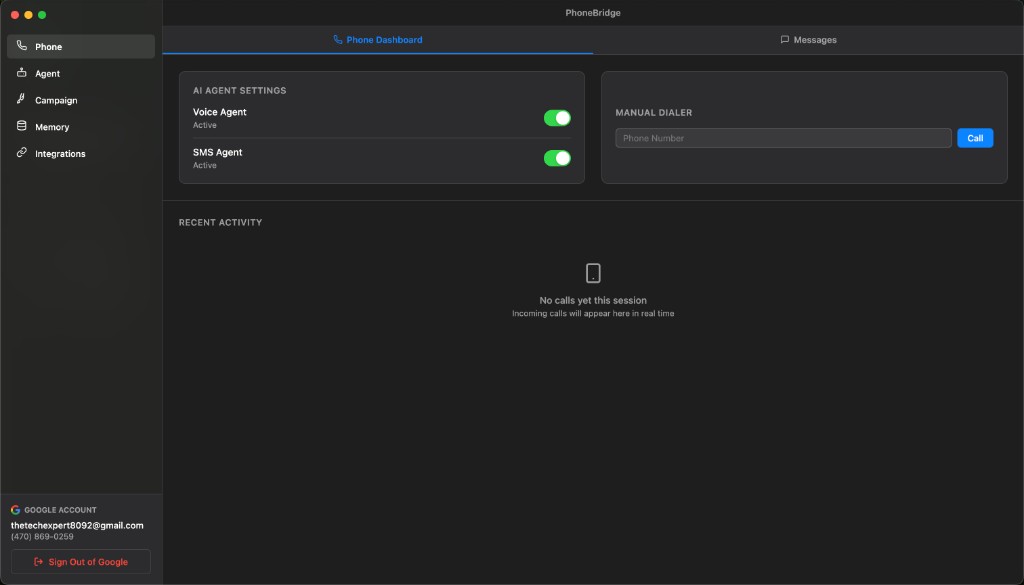
Every working business has a phone number. Most don’t have someone available to answer it every hour. The result is missed calls, missed leads, and a quiet kind of churn that no dashboard catches.
PhoneBridge is the AI receptionist for that phone line. It runs as a native desktop app on Mac and Windows, signs in to your existing Google Voice number, and handles incoming calls and SMS with an agent you configure — your business name, your prompts, your handoff rules.
What it does on day one
- Answers calls with a polite, on-brand greeting
- Replies to SMS with the same instructions
- Optional IVR menu for callers who prefer keypad navigation
- One-click takeover so you can step into any live call
- Caller memory so repeat callers aren’t starting from zero
- Outbound campaigns from a CSV upload
Why a desktop app
We chose a desktop app over a hosted service for two reasons. First, your Google Voice login stays on your machine — no third-party server holding the keys. Second, install is just a .dmg on Mac or .exe on Windows. No server room required.
“The phone is still where most service businesses live. We wanted to make it smarter without changing the number.”
Coming soon
PhoneBridge is in private beta. Join the waitlist and we’ll send a download link the moment your seat is ready.